We built heyEO to compare the audience a team says it serves with the audience its published content appears to describe. Then we pointed it at our own homepage.
The result was 65% audience alignment. That number could easily become a dramatic marketing line: our own website had “35% drift.” It would also be a poor reading of the report.
The useful part was underneath the headline.
What the scan observed
The scan used one source page: the heyEO homepage as it appeared on 13 September 2026. It compared our declared ideal customer profile with evidence inferred from that page across seven dimensions.
The report recorded:
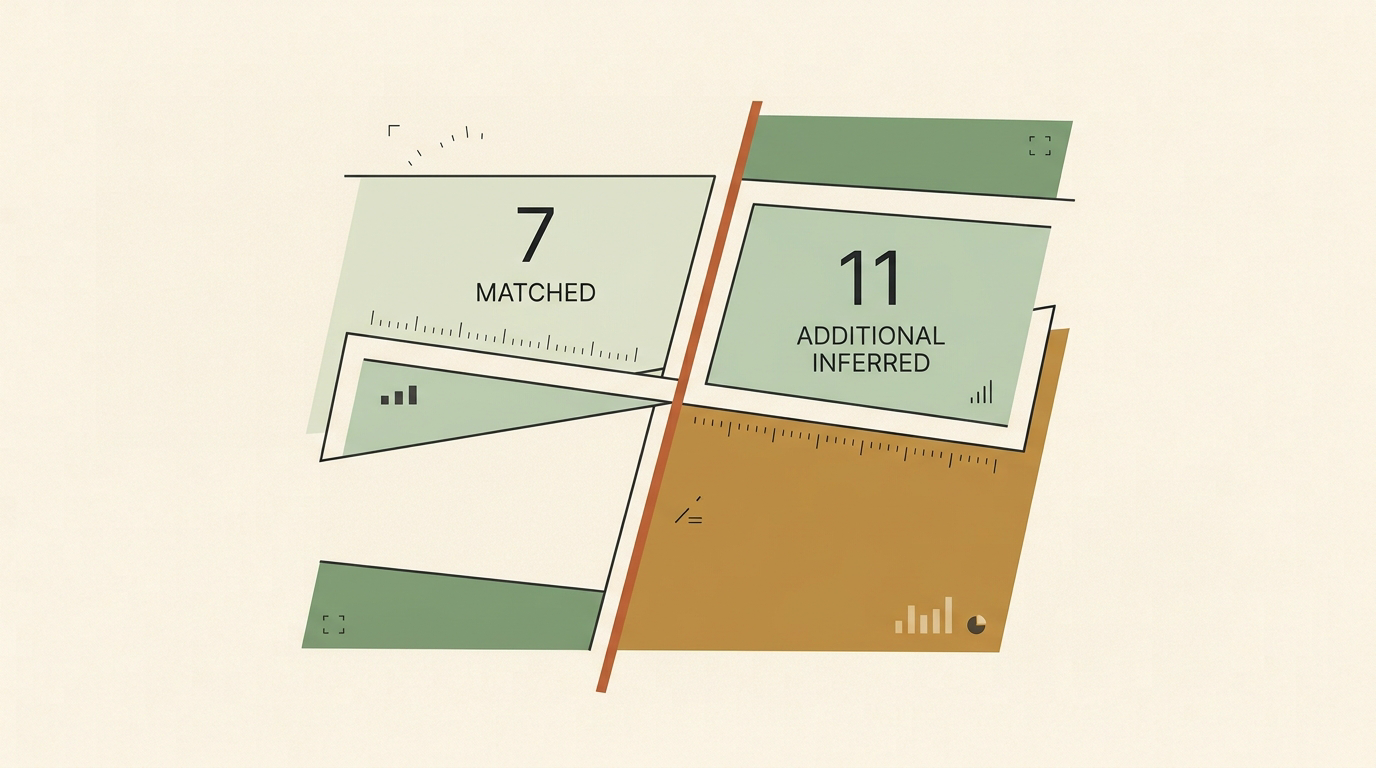
- 7 matched values;
- 0 declared values missing from the page;
- 11 additional values inferred from the page;
- 3 of 7 dimensions containing drift items; and
- 18 inferred values in total.
Company size, roles, and industries matched cleanly. The page supported the audience we intended: founders or solo marketers at SaaS and AI startups with teams under ten people.
The drift appeared in pain points, buying triggers, and use cases. In other words, the homepage did not contradict the declared audience. It said more than our declaration did.
“Extra” does not automatically mean “wrong”
The homepage discussed several problems: not knowing how AI answers describe the product, content speaking to a different buyer, technical blockers for crawlers, and audits with no useful order of operations. The report also inferred buying triggers around buyers using AI assistants and use cases spanning visibility measurement, audience inference, technical audits, drift detection, and competitor tracking.
Those are real parts of the product. The issue was not that the page had invented a second audience. The declared ICP was simply narrower than the collection of jobs and triggers visible in the copy.
That distinction matters. Deleting every “extra” signal would make the page less useful. Blindly adding every inferred phrase to the declared ICP would make the audience definition less useful. The right response is editorial: decide which ideas belong in the core promise, which are supporting capabilities, and which create unnecessary breadth.
The actual gap was maturity
The report found insufficient evidence for buyer maturity. The homepage said “small team” and “no specialist,” but it did not state clearly where that team was in its journey.
That prompted a sharper qualification: heyEO is for a launched, English-language SaaS or AI product with content already published and no dedicated SEO or AEO specialist. A pre-content team does not yet have the evidence loop heyEO is designed to support.
This is a more useful change than trying to push the alignment number upward. It helps the right reader recognize themselves and helps the wrong reader opt out.
Why we are not treating 65% as a grade
ICP alignment and confidence are model estimates for a particular scan. They are not a score for the quality of the site, and they do not prove that a phrase caused an audience to form an opinion.
This report also had a one-page evidence base. That is enough to review the homepage message; it is not enough to characterize every page, campaign, or buyer conversation. A later scan may infer different wording even when the broad pattern remains similar.
The disciplined reading is:
- preserve the matched audience signals;
- make buyer maturity explicit;
- organize the extra pains and use cases under one evidence-loop story; and
- scan again after the content change to observe what moved.
The final step will still not prove causation. It will give us a comparable record of the site before and after an intentional change.
Dogfooding should create constraints
Publishing a flattering score is easy. Publishing the evidence, the awkward parts, and the limits is more useful.
Our takeaway was not “heyEO says heyEO is good.” It was that the core audience was present, the product story was broader than the declaration, and the maturity signal needed work. That is specific enough to act on and cautious enough to revisit.
You can inspect heyEO's latest public report or use the Getting Started guide to run the same kind of evidence loop on your own site.