Answer engine optimization can quickly become a list of disconnected tactics: add schema, publish more articles, collect mentions, rewrite headings, create comparison pages. A small team can spend weeks doing “AEO work” without knowing which observation led to which decision.
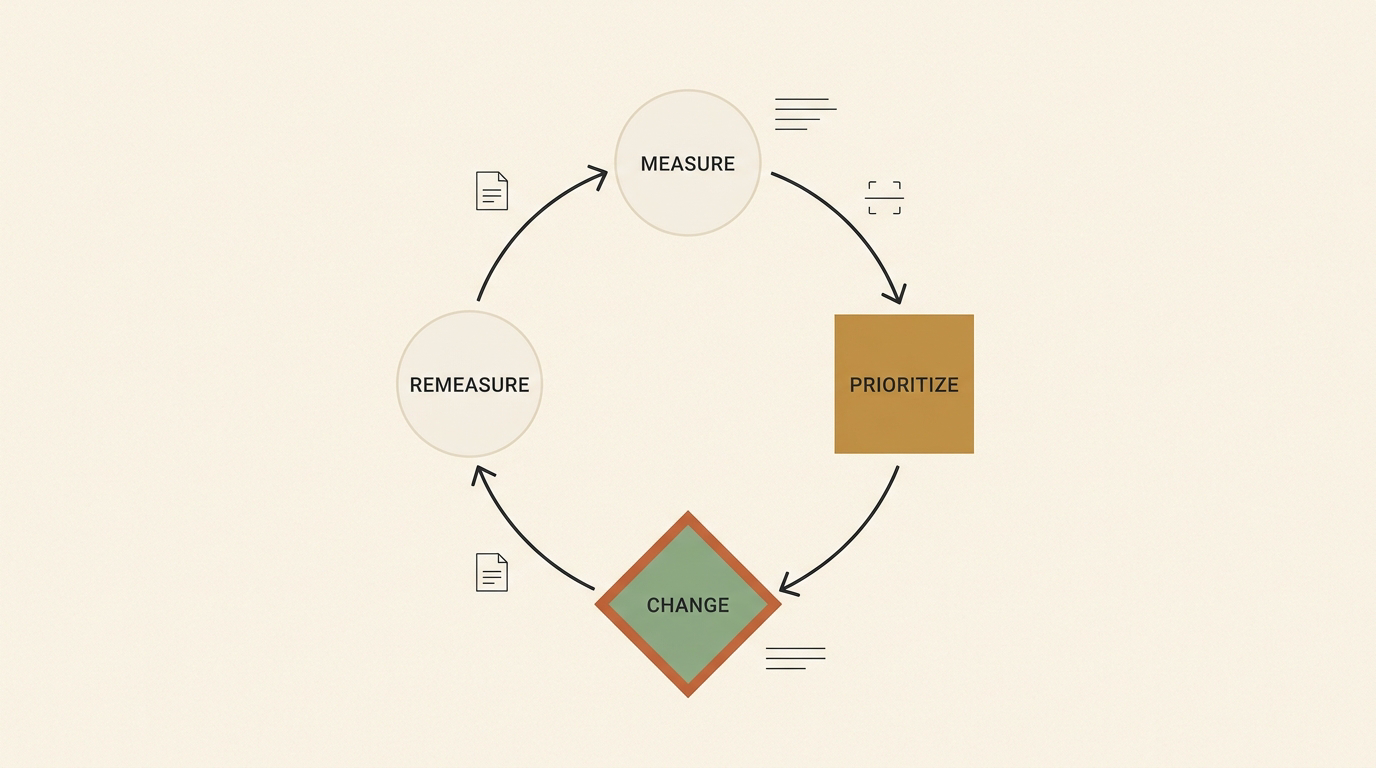
A tighter workflow has four steps: measure, prioritize, change, and remeasure.
The point is not to guarantee an outcome. It is to keep the evidence, decision, intervention, and later observation connected.
1. Measure a defined surface
Begin with a scan whose scope you can describe. Record the pages crawled, the prompts measured, the answer engines used, and the time of the run.
The evidence will not all have the same status:
- crawlability, metadata, headings, canonicals, and structured data are deterministic observations;
- inferred audience values and model confidence are probabilistic estimates; and
- mentions, citations, position, and sentiment are observations from sampled answer-engine responses.
Keeping those categories separate prevents a technical failure and a model estimate from being flattened into one mysterious score.
2. Prioritize one change
An audit can be correct and still be unusable. Fifty findings do not tell a founder what deserves this afternoon.
Prioritization should consider likely impact, confidence in the evidence, effort, and current capacity. It should also preserve the source: which page, prompt, answer, or check made this recommendation relevant?
Choose a change small enough to identify later. “Improve AI visibility” is not an intervention. “Clarify the buyer maturity on the homepage” or “restore crawl access to the product documentation” is.
Priority is a planning decision, not a prediction. A high-priority recommendation can still produce no observable movement in the next scan.
3. Record what changed
Before editing, retain the original scan as the comparison basis. Track the recommendation and record the implemented change once it is real.
Useful intervention notes answer:
- what changed;
- where it changed;
- when it changed; and
- which recommendation prompted the work.
They should not claim an outcome before the later measurement exists.
This step sounds administrative, but it is what separates a measurement loop from a dashboard. Months later, the team can still distinguish “the model changed” from “we changed this page between these two runs.”
4. Remeasure comparably
Run another scan after the change has had a reasonable chance to be discovered. Use the same prompt and provider identities when evaluating AI visibility, and keep the relevant crawl scope consistent.
Comparability may differ by section. The site audit can remain comparable even if a provider was removed from the AI measurement. ICP evidence may be carried forward from an earlier scan rather than remeasured. A useful report makes those limits visible instead of hiding the whole comparison or pretending every section is equivalent.
Describe the result as observed movement:
- the finding was resolved in the later crawl;
- the monitored mention rate was higher or lower;
- the inferred audience evidence changed; or
- no material difference was observed.
Do not turn “after” into “because of.” Other sources, provider behaviour, crawl timing, and model variation can also affect the result.
Repeat with the next justified action
The loop creates a durable sequence:
- completed measurement;
- evidence-backed decision;
- recorded intervention; and
- comparable later evidence.
That sequence is modest by design. It gives a founder something more valuable than a promise: a record of what the team knew, what it chose, and what it observed next.
Start with the product walkthrough in Getting Started. When the workflow needs to run from CI or a script, continue to the API Docs.